


A customer portal that replaced the weekly status email.
The Friday email stopped in week nine. Eleven hours a week came back to the operations team, inbound “where is my shipment” calls fell by more than half, and two new customers were onboarded without a call.
01 · The situation
What it was costing them before we started.
Shipment status, documents and exceptions lived in the TMS, a spreadsheet and three people’s inboxes. Customers asked, someone looked it up, someone replied. Every Friday, a status email went to forty accounts, compiled by hand.
- 40 accounts on the Friday status email, compiled by hand from three systems.
- 6 hrs a week spent building that email, before a single customer replied to it.
- 3 people who could answer “where is my shipment”, and none of them full time.
02 · The approach
How we went about it.
We started in the Dallas office, sitting with the operations team while they answered real customer calls. We counted the questions rather than asking what they were, because the answer to “what do customers ask?” is never the same as the log. Eleven of the top fifteen questions turned out to be answerable from data the TMS already held.
- Day 1
Shadowed two ops coordinators for a full shift. Logged 63 inbound questions and where each answer came from.
- Day 2
Mapped the eleven answerable questions to TMS fields, agreed the four that needed a person, and priced the build.
- Week 1
We agreed the price and signed, and set everything up in the client’s own accounts.
03 · What we built
The pieces, and what each one is for.
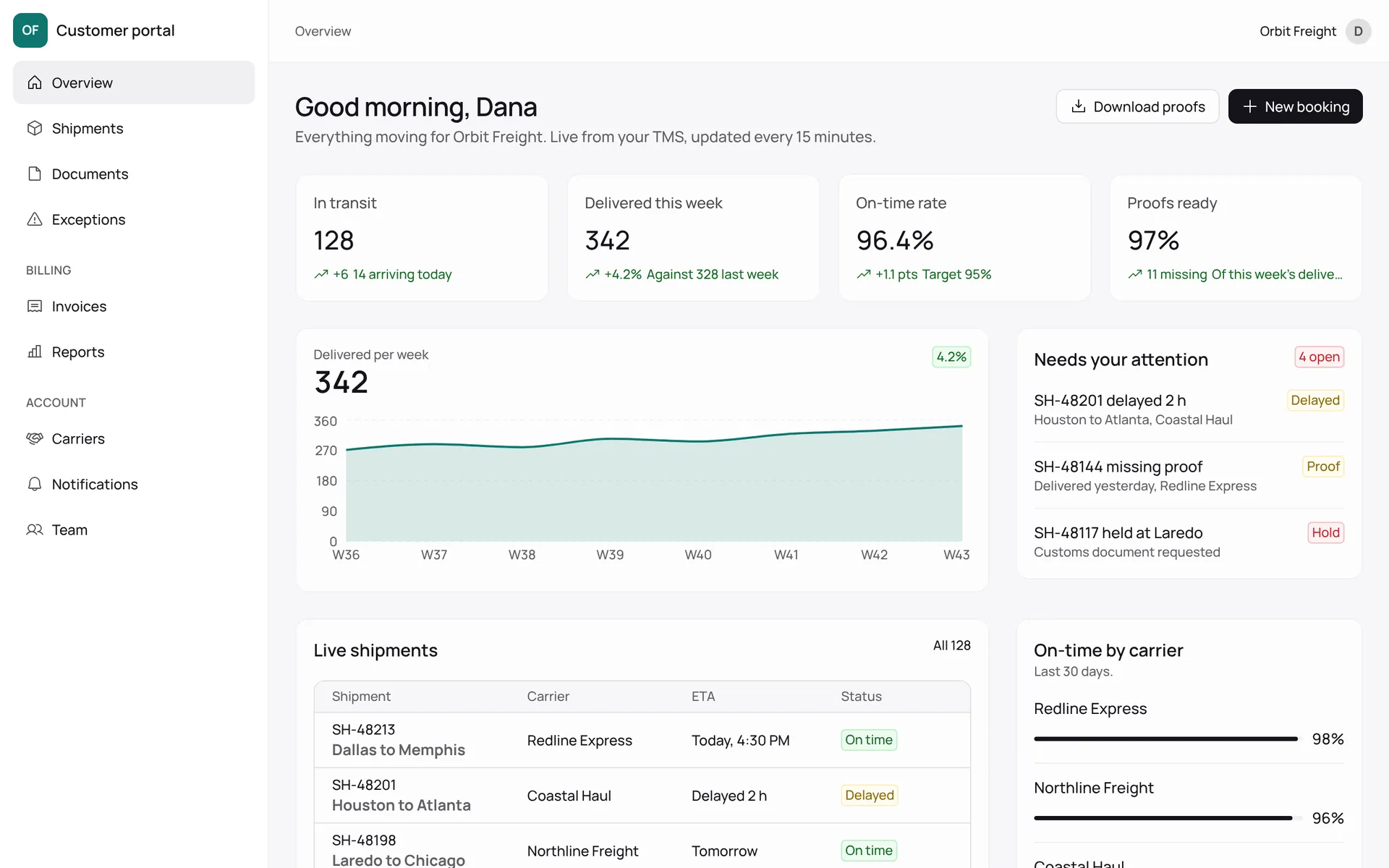
A customer portal on top of the existing TMS. Customers see their shipments, documents and exceptions live, download proofs of delivery, and get notified when something changes. Roles for customer, carrier and internal staff. Single sign-on for the ops team.
- Live shipment view
Every shipment with status, ETA and exception reason, read from the TMS every four minutes. The same field the coordinator used to read out loud.
- Documents and proofs
Proof of delivery, BOL and customs paperwork attached to the shipment, downloadable without asking.
- Exceptions, pushed
A delay or a damage notifies the account contact when it happens, rather than on Friday. Configurable per customer.
- Roles and sign-on
Customer, carrier and internal roles. The ops team signs in with the accounts they already have.
04 · The result
What changed, and by how much.
- Hours a week on status reporting 11 hrs 0 hrs
- Inbound “where is my shipment” calls, weekly 94 41
- Time to answer a status question 18 min instant
- Accounts onboarded without a call 0 2
Measured June 2026, from client records.
We stopped explaining where things were and started shipping them.
Does this sound a bit like your week?
Tell us how it works at your place today, and we’ll tell you honestly what it would take.
Book a 15-minute callNot ready to talk yet? Take the build-or-buy check